



项目概述
SymPy是一个用纯Python编写的计算机代数系统,旨在提供符号数学计算功能,帮助用户进行复杂的数学运算和科学计算。
项目地址
https://github.com/sympy/sympy
项目页面预览
关键指标
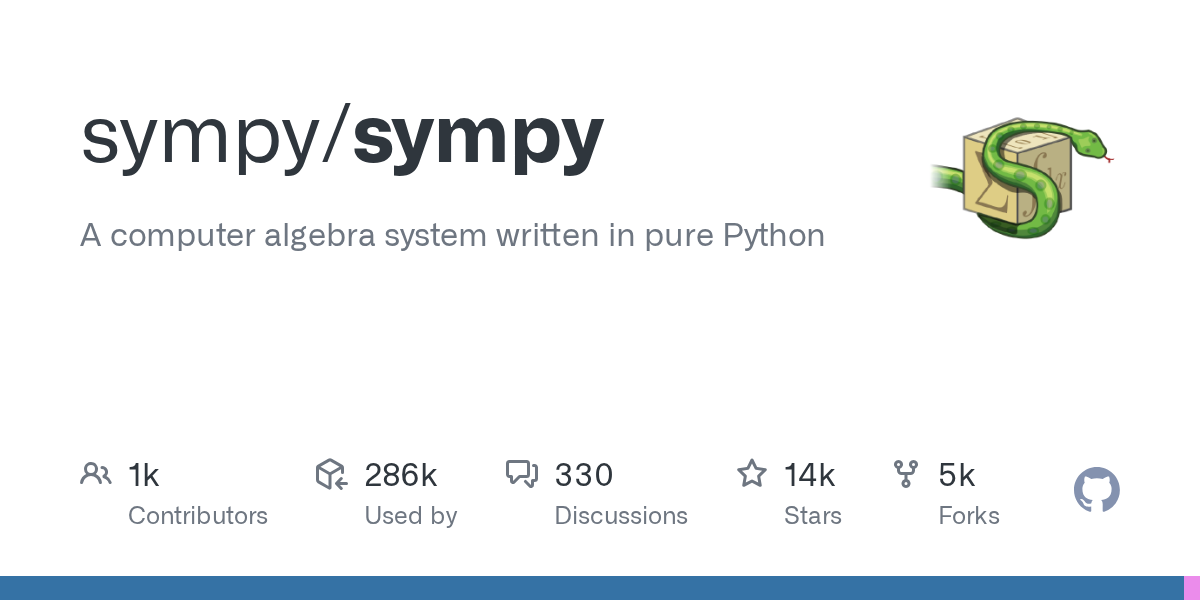
- Stars:14316
- 主要语言:Python
- License:Other
- 最近更新:2026-01-14T13:57:01Z
- 默认分支:master
本站高速下载(国内可用)
点击下载(本站镜像)
– SHA256:2594500a5ed80cc4810bf00064379a254a7008d39f2df0b09a896916594fcccd
安装部署要点(README 精选)
Documentation and Usage
For in-depth instructions on installation and building the
documentation, see the SymPy Documentation Style Guide.
Everything is at:
You can generate everything at the above site in your local copy of
SymPy by:
$ cd doc
$ make html
Then the docs will be in _build/html. If
you don’t want to read that, here is a short usage:
From this directory, start Python and:
>>> from sympy import Symbol, cos
>>> x = Symbol('x')
>>> e = 1/cos(x)
>>> print(e.series(x, 0, 10))
1 + x**2/2 + 5*x**4/24 + 61*x**6/720 + 277*x**8/8064 + O(x**10)
SymPy also comes with a console that is a simple wrapper around the
classic python console (or IPython when available) that loads the SymPy
namespace and executes some common commands for you.
To start it, issue:
$ bin/isympy
from this directory, if SymPy is not installed or simply:
$ isympy
if SymPy is installed.
Installation
To install SymPy using PyPI, run the following command:
$ pip install sympy
To install SymPy using Anaconda, run the following command:
$ conda install -c anaconda sympy
To install SymPy from GitHub source, first clone SymPy using git:
$ git clone https://github.com/sympy/sympy.git
Then, in the sympy repository that you cloned, simply run:
$ pip install .
See https://docs.sympy.org/dev/install.html for more information.
常用命令(从 README 提取)
(未提取到命令块)
通用部署说明
- 下载源码并阅读 README
- 安装依赖(pip/npm/yarn 等)
- 配置环境变量(API Key、模型路径、数据库等)
- 启动服务并测试访问
- 上线建议:Nginx 反代 + HTTPS + 进程守护(systemd / pm2)
免责声明与版权说明
本文仅做开源项目整理与教程索引,源码版权归原作者所有,请遵循对应 License 合规使用。




暂无评论内容