



项目概述
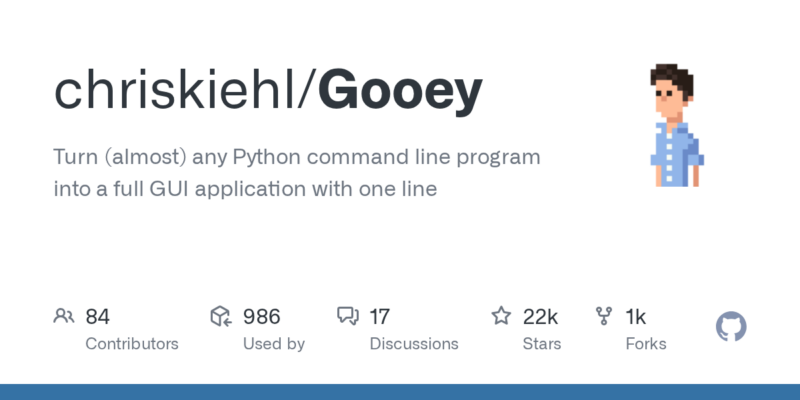
Gooey 是一个工具,可以将几乎所有的 Python 命令行程序轻松转换为完整的图形用户界面应用,只需一行代码即可实现,极大地方便了用户操作。
项目地址
https://github.com/chriskiehl/Gooey
项目页面预览
关键指标
- Stars:22017
- 主要语言:Python
- License:MIT License
- 最近更新:2025-07-12T11:24:40Z
- 默认分支:master
本站高速下载(国内可用)
点击下载(本站镜像)
– SHA256:49d8cc92132b60c92adc84f8042332754e50b6ffa621b17694f2849e8eeb7093
安装部署要点(README 精选)
Installation instructions
The easiest way to install Gooey is via pip
pip install Gooey
Alternatively, you can install Gooey by cloning the project to your local directory
git clone https://github.com/chriskiehl/Gooey.git
run setup.py
python setup.py install
Usage
Gooey is attached to your code via a simple decorator on whichever method has your argparse declarations (usually main).
from gooey import Gooey

@Gooey      <--- all it takes! :)
def main():
  parser = ArgumentParser(...)
  # rest of code
Different styling and functionality can be configured by passing arguments into the decorator.
# options
@Gooey(advanced=Boolean,          # toggle whether to show advanced config or not
       language=language_string,  # Translations configurable via json
       auto_start=True,           # skip config screens all together
       target=executable_cmd,     # Explicitly set the subprocess executable arguments
       program_name='name',       # Defaults to script name
       program_description,       # Defaults to ArgParse Description
       default_size=(610, 530),   # starting size of the GUI
       required_cols=1,           # number of columns in the "Required" section
       optional_cols=2,           # number of columns in the "Optional" section
       dump_build_config=False,   # Dump the JSON Gooey uses to configure itself
       load_build_config=None,    # Loads a JSON Gooey-generated configuration
       monospace_display=False)   # Uses a mono-spaced font in the output screen
)
def main():
  parser = ArgumentParser(...)
  # rest of code
See: How does it Work section for details on each option.
Gooey will do its best to choose sensible widget defaults to display in the GUI. However, if more fine tuning is desired, you can use the drop-in replacement GooeyParser in place of ArgumentParser. This lets you control which widget displays in the GUI. See: GooeyParser
from gooey import Gooey, GooeyParser

@Gooey
def main():
  parser = GooeyParser(description="My Cool GUI Program!")
  parser.add_argument('Filename', widget="FileChooser")
  parser.add_argument('Date', widget="DateChooser")
  ...
常用命令(从 README 提取)
parser = ArgumentParser()
search_group = parser.add_argument_group(
    "Search Options",
    "Customize the search options"
)

search_group.add_argument(
    '--query',
    help='Base search string'
)

@Gooey(menu=[{}, {}, ...])
通用部署说明
- 下载源码并阅读 README
- 安装依赖(pip/npm/yarn 等)
- 配置环境变量(API Key、模型路径、数据库等)
- 启动服务并测试访问
- 上线建议:Nginx 反代 + HTTPS + 进程守护(systemd / pm2)
免责声明与版权说明
本文仅做开源项目整理与教程索引,源码版权归原作者所有,请遵循对应 License 合规使用。

暂无评论内容